Masterclasses & Workshops
Improvisation · composition · gypsy jazz and modern language
Pere Soto Jazz Workshop ’26
A one-week intensive workshop with a full study programme. Composition and improvisation for instrumentalists: form, language, and how to build a solo that belongs to the piece.
Download dossier 2026The 7 Secrets of Improvisation
Jazz idea and concepts inspired by The Art of Improvisation by Bob Taylor
A masterclass on the tools used on stage, organised as seven working principles:
- Melody
- Rhythm
- Expression
- Development
- Harmony
- Performance
- Analysis
From Django to Wes
Masterclass — Castelló Jazz Festival, 2012
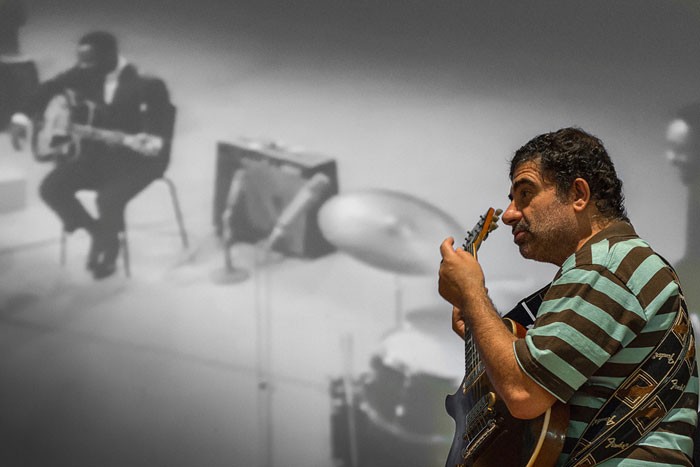
A masterclass devoted to two of the most revolutionary figures in the history of jazz guitar: Django Reinhardt and Wes Montgomery.
Through a comparative study of their languages, it asks a basic question: true musicality does not necessarily live in technical perfection or in an established method, but in the ability to develop a language of one’s own.
Django and Wes represent two radically personal paths. Their instrumental techniques were unconventional, and yet both reached an extraordinary level of expression and recognition. Their differences — and their points of contact — show how technique, sound, articulation, phrasing, rhythm and melodic conception can become the elements of a personal language.
The session includes transcribed solos, recordings and audiovisual material, plus live demonstrations by Pere Soto, placing the resources of both guitarists side by side.
The path finally distinguishes master from genius: Wes Montgomery as an extraordinary master whose language founded a vast school, especially in jazz and Latin jazz; Django Reinhardt as an absolute, unique and unrepeatable genius, whose musical personality escapes any method or school.
The aim is not to imitate Django or Wes, but to understand how two musicians found their own voice — and what we can learn from that in order to find ours.
Gypsy Jazz course
After more than forty years inside the style, with publications and transcriptions devoted to Django Reinhardt, transmitting gypsy jazz to new generations is both an honour and a duty. Django himself said that what he played was jazz.
Day plan
- 10:00–12:00 — Double bass and rhythm guitar
- 12:00–13:00 — Solo guitar
- 13:00–14:00 — Style and analysis of Django Reinhardt and of today’s Manouche players, Roma and non-Roma
- 14:00–15:00 — Jam session
The bass in gypsy jazz
It looks like the simplest instrument in the style. Its secret is groove and time, together with the instrument’s typical phrases and the way swing was played in that era — different, and personal.
Rhythm guitar — the pompe
Manouche rhythm guitar exists to support the soloist. That feel is called pompe. What sets it apart from traditional swing is a rocking flexibility made of accents and dynamics. In a way it replaces the drums of the Charleston era. Before becoming a strong soloist one has to master the art of the pompe; that takes years. Rhythm, dynamics and volume all belong to it.
Subjects: right-hand technique, left-hand technique, harmony, breaks and rolls, tremolos, pick and strings, Manouche repertoire, musette waltz.
Solo guitar
The soloist’s work is the most demanding: years of study for agility, craft, invention and emotional force, so that one can solo for hours without losing freshness or the listener’s attention. The soloist must also know the pompe.
Subjects: right and left hand, harmony, breaks, rolls and tremolos, pick and strings, repertoire and musette waltz, rest-stroke and sweeping, inversions, scales and arpeggios, ornaments and typical effects, licks and language, voicings, improvisation as the main language, harmonics.
Django Reinhardt — style and analysis
Solos, chords, phrases, pick technique, films and transcriptions.
Manouche guitarists today — Roma and non-Roma
The same tools of analysis applied to the living scene.