Europe · Amsterdam 1990–2000
Amsterdam · Bill Gerhardt Quartet · Metanoic · Particular Vernacular · European scene
This dossier covers the European stage centered in Amsterdam: the partnership with pianist Bill Gerhardt, the recording of Metanoic (1992), the New York sessions for Particular Vernacular (1994), and sustained activity across the Netherlands and the wider European jazz circuit.
Profile
After the formative years in Catalonia and a first contact with the European scene via Berlin, Pere Soto settles in Amsterdam. The city offers an international atmosphere, intense musical activity and a strong presence of jazz and improvised music — the right environment for the next phase of his trajectory.
The central collaboration of this period is the Pere Soto & Bill Gerhardt Quartet. With Dutch and American partners, the group develops a language that moves between European jazz, open improvisation and a clear compositional identity. Two recordings mark the decade: Metanoic (Hilversum, 1992) and Particular Vernacular (New York, 1994).
Scope note
This page documents the Amsterdam-centered European stage (c. 1990–2000). Some concert dates, festival listings and press items are still being verified as the archive is reconstructed. Particular Vernacular is included here as a bridge toward the United States; a dedicated USA dossier expands that strand.
Documented timeline
| Year | Milestone | Source / scope |
|---|---|---|
| c.1990 | Move from Berlin to Amsterdam. Beginning of sustained professional activity in the Netherlands. | Artist biography / trajectory notes. |
| 1990 | 3rd Zuid-Nederlands Jazz Festival, De Effenaar, Eindhoven. Friday 25 May, 20:00: Niko Langenhuijsen, Tom Cora, Pere Soto. Local review closes on the Dutch-Spanish duo. | Festival poster; press clipping, May 1990. |
| Early 1990s | Formation and activity of the Pere Soto & Bill Gerhardt Quartet (with Dutch rhythm section including John Engels and Arjen Gorter in documented line-ups). | Artist discography; programme notes. |
| 1992 | Recording of Metanoic in Hilversum with Bill Gerhardt Quartet. Selected best album of the month and top 12 of the year by the Jazz South Art Federation (USA); airplay on more than 140 US stations. | Discography; Jazz South Art Federation; CV. |
| 1990s | Concerts across the Netherlands (Amsterdam, Eindhoven, Utrecht, Zwolle, Culemborg and others) and European festival appearances (including St. Johann, Austria; Dutch jazz festivals). | Artist archive; venue documentation. |
| 1994 | Recording of Particular Vernacular in New York with Jeff Ballard, Ben Allison, Dave Douglas, Dave Liebman, Bill Gerhardt and Pere Soto. Bridge toward the US stage. | Discography; session credits. |
| c.1994 | Masterclass at Wake Forest University (Winston-Salem, North Carolina) and related concerts in North and South Carolina. | CV / pedagogical notes. |
| Late 1990s | Continued European activity; later sources also note North Sea Jazz Festival involvement (e.g. with Big John Patton, 1999 — to be further verified). | Biography; festival listings. |
Highlighted milestones
Amsterdam · a new base
After Berlin, Amsterdam becomes the operational centre of the European stage: an international city with a dense jazz and improvised-music scene, and a platform for touring the Netherlands and neighbouring countries.
Pere Soto & Bill Gerhardt Quartet
Core ensemble of the period. The collaboration with pianist Bill Gerhardt shapes both the live work and the two main recordings of the decade, combining European sensibility with American jazz language.
Metanoic · Hilversum, 1992
Recorded in Hilversum with the Bill Gerhardt Quartet. Recognised by the Jazz South Art Federation (USA) as best album of the month and among the top 12 of the year, with broadcast on more than 140 US radio stations — an early international footprint from the Amsterdam base.
Particular Vernacular · New York, 1994
Recorded in New York with Jeff Ballard, Ben Allison, Dave Douglas, Dave Liebman, Bill Gerhardt and Pere Soto. The session links the European project to the American scene and opens the path toward a dedicated United States chapter of the archive.
1990 · 3rd Zuid-Nederlands Jazz Festival · Eindhoven
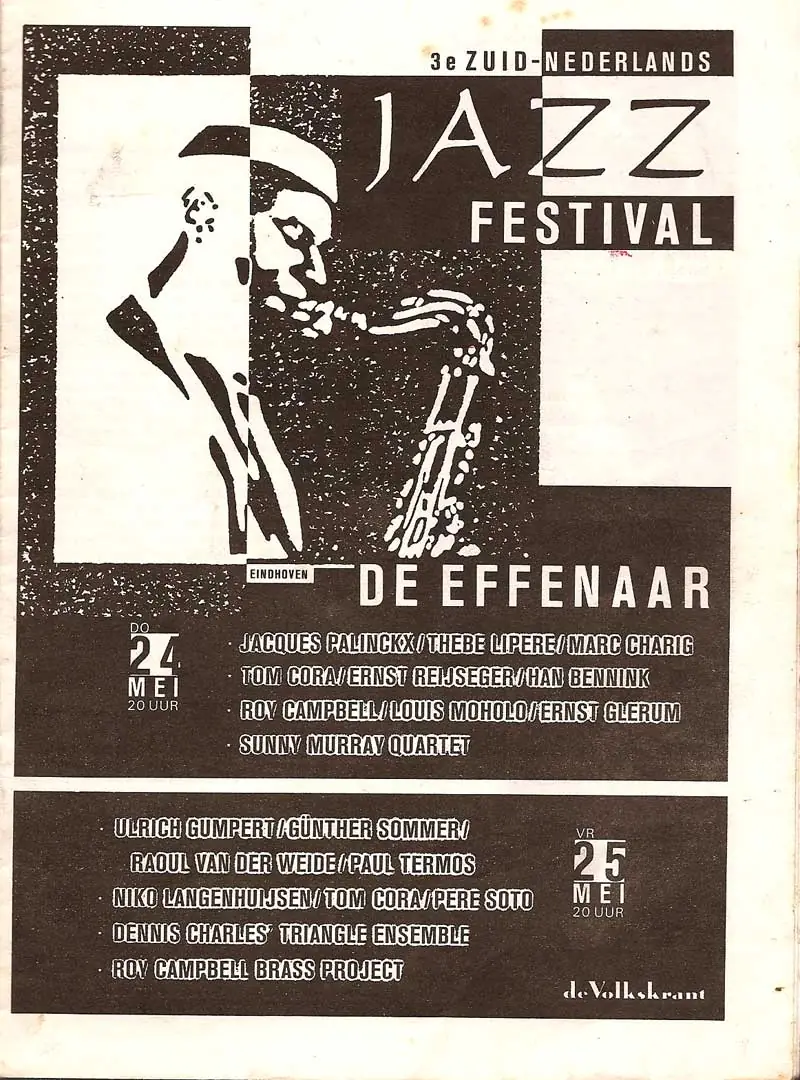
On the Friday bill with Ulrich Gumpert, Günther Sommer, Raoul van der Weide, Paul Termos, the Dennis Charles Triangle Ensemble and the Roy Campbell Brass Project. The local review closed on the Dutch-Spanish duo of Pere Soto and Niko Langenhuijsen: own compositions, jazz and flamenco in the guitar, a raw and virtuosic set, and a standing ovation. The same page also covered Tom Cora’s tribute to Karel Appel. The newspaper photo caption reads Niels Langenhuizen; the poster billing is Niko Langenhuijsen.
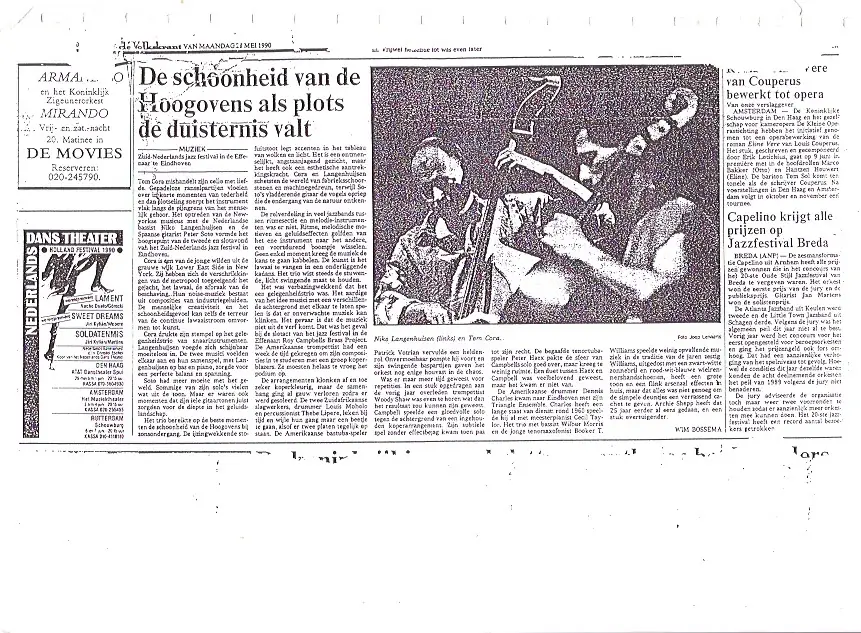
The beauty of the Hoogovens when suddenly darkness falls
Music. Zuid-Nederlands Jazz Festival at the Effenaar, Eindhoven. Translation of the local review.
Tom Cora is one of the young wild ones from the Lower East Side in New York. He is an extremely adventurous, unconventional musician, yet there is something authentic about him, an unguarded freshness, and at the same time he is a virtuoso on his instrument. His solo pieces, strewn with dissonance, reach an intensity that is rarely heard. Human emotion, the spectacle of the dance, and the terror of continuous transformation become art.
Cora paid tribute to the abstract expressionism of the Dutch painter Karel Appel. The music of Appel’s paintings, which played an important role in the Cobra movement in the 1950s, was translated by Cora into sound.
The evening closed with the Dutch-Spanish duo of guitarist Pere Soto and bassist Niko Langenhuijsen. They played a programme of their own compositions, in which Soto’s guitar had a central role. Soto, who lives in New York, comes from jazz and flamenco, and his playing mixes the two.
The duo brought the night to a high point, with an energetic and virtuosic performance. Soto’s guitar work was technically brilliant and emotionally charged. Langenhuijsen’s bass gave a solid foundation. The interaction between the two was remarkable, and the music had a raw, unpolished quality that fitted the atmosphere of the festival.
The night ended with a standing ovation for the duo, who had managed to captivate the room with their mix of jazz, flamenco and the avant-garde.
European concerts & festivals
Regular activity in Dutch cities (Amsterdam, Eindhoven, Utrecht, Zwolle, Culemborg and others) and festival appearances, including St. Johann (Austria) and major Dutch jazz festivals. Documentation of specific dates is being expanded.
Documentation of the stage
- Photographs of the Bill Gerhardt Quartet and European performances
- Concert posters and programmes (Netherlands and festivals)
- 3rd Zuid-Nederlands Jazz Festival, Eindhoven, 24-25 May 1990: poster and local review
- Press and radio references for Metanoic (including Jazz South Art Federation)
- Session and release documentation for Particular Vernacular
- Festival listings and venue archives
- Pedagogical activity (Wake Forest University and related)
Closing note
1990–2000 · The European stage takes shape
From Berlin to Amsterdam.
From the Dutch scene to New York sessions.
A decade of partnership, recording and international projection — and the bridge toward the United States.